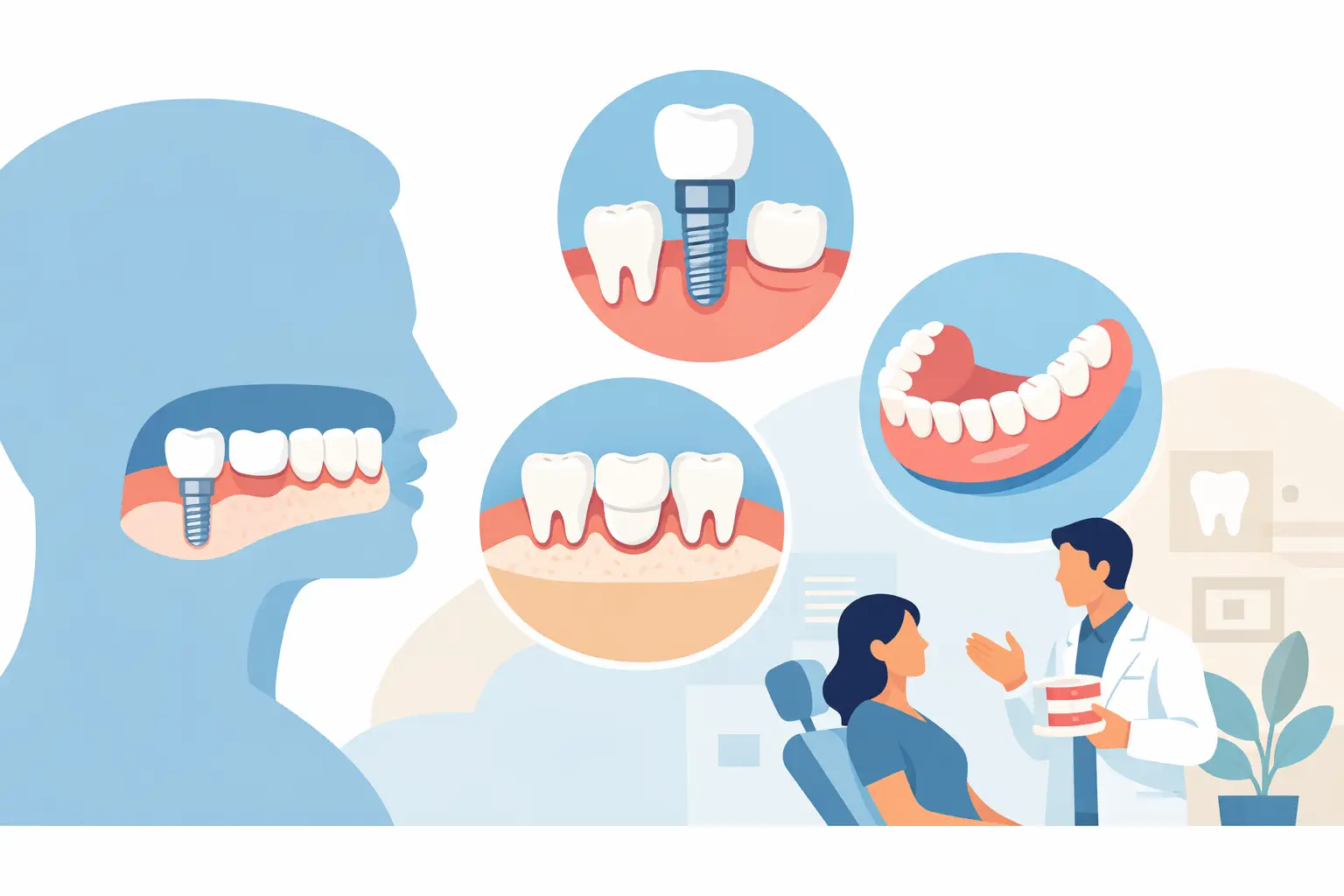
A missing tooth changes more than your smile. It can affect how you chew, how clearly you speak, how your bite fits together, and how confident you feel in everyday conversations. If you are comparing the best options for missing teeth, the right answer depends on how many teeth are missing, the health of your jawbone and gums, your long-term goals, and whether you want the closest thing to natural teeth.
For some patients, replacing one tooth quickly is the priority. For others, the bigger issue is a failing bite, multiple missing teeth, or dentures that no longer feel stable. This is where a careful evaluation matters. The best treatment is not always the cheapest upfront, and the fastest solution is not always the one that protects your oral health for years to come.
What are the best options for missing teeth?
The main treatments are dental implants, dental bridges, partial dentures, full dentures, and full-arch implant solutions such as All-on-4 or All-on-X. Each option has strengths and limitations. A good recommendation should account for comfort, function, appearance, maintenance, and what your mouth will need five or ten years from now.
If you are missing a single tooth, a dental implant is often considered the top long-term option because it replaces both the visible tooth and the root. If you are missing several teeth in a row, a bridge or multiple implants may make sense. If you are missing most or all teeth, implant-supported full-arch treatment can offer far more stability than traditional dentures. The detail that matters most is whether the solution is preserving your health as well as restoring your smile.
Dental implants: the closest replacement to a natural tooth
Dental implants are widely regarded as one of the best options for missing teeth because they are designed to act like tooth roots. A small titanium implant is placed in the jawbone, where it supports a crown, bridge, or full-arch prosthesis. That support matters because the jawbone needs stimulation to maintain its shape and density.
From a functional standpoint, implants are hard to beat. They do not rely on neighboring teeth for support, they feel more secure than removable appliances, and they help patients bite and chew with more confidence. Aesthetically, they can also produce very natural-looking results when planned carefully.
That said, implants are not a one-size-fits-all answer. They require enough bone for support, or the ability to rebuild that foundation through grafting. They also involve a surgical process and a greater initial investment than a removable option. For many adults, though, that investment pays off in comfort, durability, and quality of life.
Patients with bone loss, long-term tooth absence, or advanced dental breakdown may need additional procedures such as bone grafting or sinus grafting before implants are placed. In experienced hands, those steps are part of comprehensive planning, not a setback.
Best for single missing teeth
When one tooth is missing and the teeth on either side are healthy, a single implant is often the most conservative long-term treatment. A traditional bridge may restore the space, but it usually requires reshaping the neighboring teeth. An implant leaves those teeth untouched.
Best for multiple missing teeth
If several teeth are missing, implants can support individual crowns or an implant bridge. The right design depends on spacing, bite forces, and the overall condition of the mouth.
Dental bridges: faster in some cases, but with trade-offs
A dental bridge fills the gap by anchoring an artificial tooth to the teeth next to the missing space. Bridges have been used successfully for many years and can be an effective option when adjacent teeth already need crowns or when implant treatment is not ideal.
One advantage is timing. In some cases, a bridge can be completed faster than an implant because it does not require healing around a surgically placed root replacement. For patients focused on restoring appearance and function without surgery, that may be appealing.
The trade-off is that a traditional bridge depends on neighboring teeth for support. If those teeth are healthy, preparing them may not be the most conservative choice. Bridges also do not replace the root, which means the underlying bone in the missing-tooth area may continue to shrink over time.
A bridge can be a strong option when the case is selected well. It is simply important to look beyond the short term and ask how that restoration will affect the rest of the mouth later.
Partial and full dentures: lower upfront cost, less stability
Dentures remain a practical option for many patients, especially when cost is a major factor or when extensive treatment is not the right fit medically. A partial denture replaces some missing teeth and usually attaches around remaining natural teeth. A full denture replaces an entire upper or lower arch.
The biggest benefit is accessibility. Dentures generally cost less upfront than implant-based care and can restore appearance relatively quickly. For some patients, that alone makes them worth considering.
The limitation is stability. Because traditional dentures rest on the gums, they can shift, rub, and reduce bite strength. Many denture wearers avoid certain foods, use adhesive regularly, or feel self-conscious speaking in social settings. Over time, the jawbone beneath a denture can also shrink, which may lead to a looser fit and changes in facial support.
Dentures still have a role in modern dentistry. But when patients want more confidence, stronger chewing ability, and a solution that feels less removable, implant-supported alternatives are often the better fit.
Full-arch implants and All-on-4: when many teeth are missing
If you are missing most or all of your teeth, or if your remaining teeth are failing, full-arch implant treatment may be the most life-changing option to consider. Systems such as All-on-4 or All-on-X use a strategic number of implants to support a fixed set of teeth for the upper arch, lower arch, or both.
This approach can dramatically improve stability compared with a removable denture. Patients often appreciate that the teeth are fixed in place, which can make eating, speaking, and smiling feel far more natural. In many cases, it also streamlines treatment by restoring a full arch with fewer implants than placing one implant for every missing tooth.
Not every patient is a candidate for the same full-arch design. Bone quality, smile line, bite pattern, health history, and esthetic goals all matter. This is where provider experience becomes especially important. Complex implant reconstruction requires both surgical precision and restorative planning. Under the care of an experienced implant provider such as Dr. Xhoana Gjelaj, patients can better understand whether a fixed full-arch solution is appropriate and what preparation may be needed for a stable, lasting result.
How to choose between the best options for missing teeth
The right choice usually comes down to five practical questions.
First, how many teeth are missing? One missing tooth calls for a different plan than a full arch of failing teeth.
Second, what condition are the surrounding teeth and gums in? If nearby teeth are already heavily restored, a bridge may be more reasonable than it would be otherwise. If the gums and bone are compromised, those issues need attention before any final restoration.
Third, do you want a removable or fixed solution? Some patients are comfortable with a removable denture. Many are not.
Fourth, what is your long-term budget? Lower upfront cost can lead to more maintenance, more remakes, or more compromise later. Higher initial investment can sometimes reduce future treatment needs.
Fifth, how important is natural feel and function? If your goal is to chew confidently, avoid movement, and keep the jawbone healthier over time, implants often rise to the top of the list.
Why expertise matters as much as the treatment itself
Tooth replacement is not just about filling a space. It is about rebuilding function, supporting the bite, preserving bone, and creating a result that looks right for your face. Poor planning can lead to cosmetic disappointment, bite problems, implant failure, or restorations that are difficult to clean and maintain.
That is why advanced diagnostics, detailed treatment planning, and credentialed implant experience matter. In complex cases, especially full-mouth restoration, the best outcome depends on seeing the whole picture rather than treating one missing tooth at a time.
For patients in Trinity, Lutz, Palm Harbor, and the greater Tampa Bay area, choosing a practice that can handle surgical and restorative care under one roof can make the process more efficient and more predictable. It also gives patients clearer communication from start to finish.
A missing tooth does not stay a small issue forever. Teeth can shift, bone can shrink, and everyday habits like eating and smiling can start to feel different in ways that are hard to ignore. The most helpful next step is not guessing which option sounds best online. It is getting a personalized evaluation that shows what will work best in your mouth, for your health, and for the way you want to live.