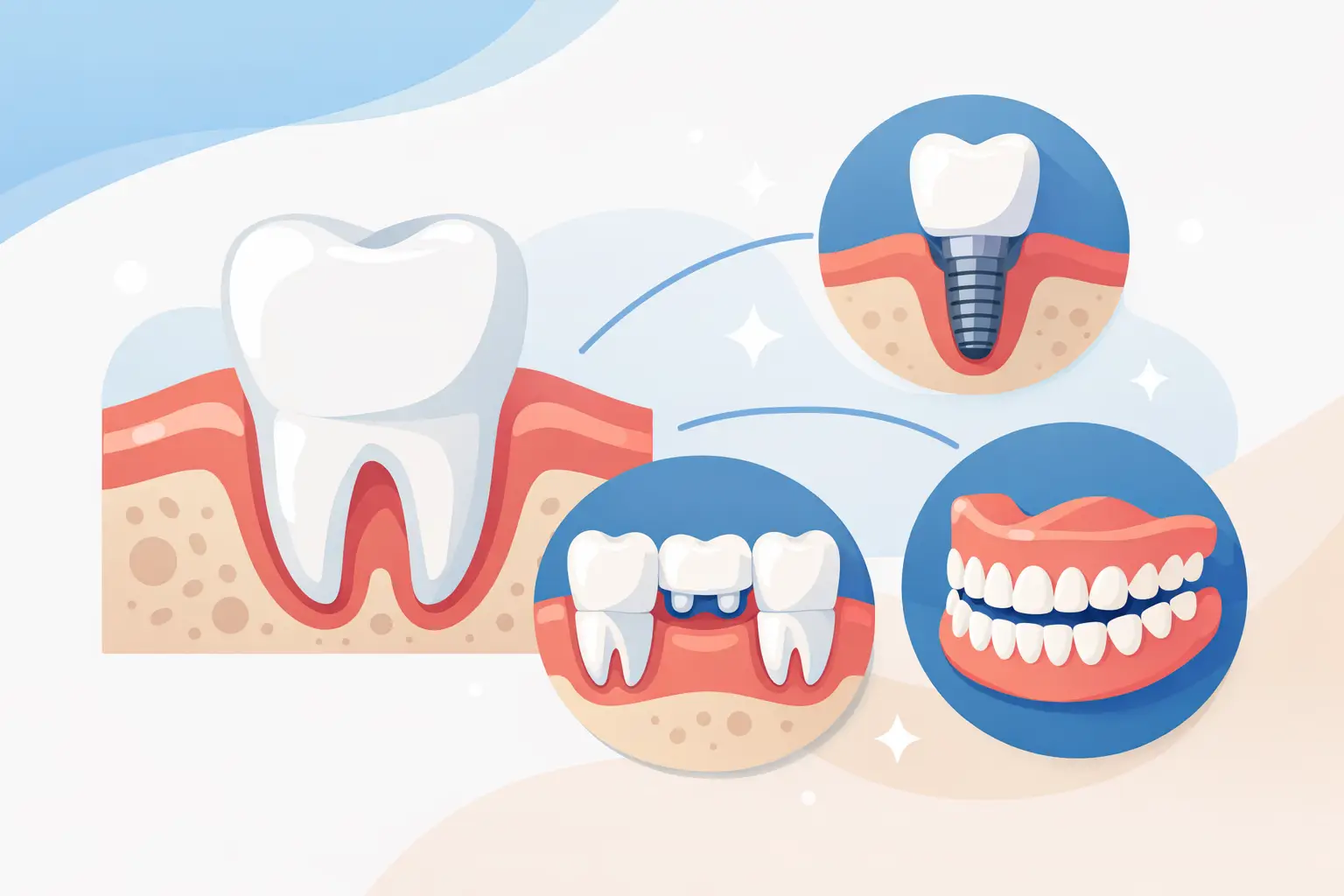
Losing a tooth changes more than your smile. It can affect how you chew, how clearly you speak, how your bite functions, and how confident you feel in everyday situations. When patients start researching the best tooth replacement options, they usually want one clear answer. The reality is that the right choice depends on how many teeth are missing, the condition of the surrounding bone and gums, your long-term goals, and how much treatment you want to take on now versus later.
For many adults, the biggest mistake is waiting too long. Missing teeth can allow neighboring teeth to shift, opposing teeth to over-erupt, and the jawbone to shrink over time. That is why tooth replacement is not just cosmetic. It is often a functional and preventive decision as well.
What are the best tooth replacement options?
The best tooth replacement options generally include dental implants, implant-supported bridges, traditional bridges, full or partial dentures, and full-arch implant solutions such as All-on-4 or All-on-X. Each option solves a different problem, and each comes with trade-offs in cost, longevity, comfort, and maintenance.
A patient missing one tooth has a very different treatment path than someone with multiple failing teeth or an unstable denture. The goal is not simply to replace what is gone. It is to restore healthy function in a way that fits your anatomy, lifestyle, and expectations.
Dental implants for single-tooth replacement
If you are missing one tooth, a dental implant is often considered the gold standard. An implant replaces the tooth root with a titanium post placed in the jawbone, then supports a custom crown on top. Because it stands on its own, it does not require the neighboring teeth to be reduced the way a traditional bridge does.
This matters more than many patients realize. Preserving natural enamel on adjacent teeth is a major advantage, especially when those teeth are healthy. Implants also help stimulate the jawbone, which can reduce the bone loss that commonly follows tooth loss.
The trade-off is that implants require adequate bone support, precise planning, and healing time. Some patients also need bone grafting before implant placement if the area has been missing a tooth for a long time. While implants usually cost more upfront than other options, they often provide the most natural look and feel and can offer the best long-term value.
Bridges can still be a strong solution
A traditional dental bridge remains a reliable option for certain patients. In this approach, the missing tooth is replaced by a prosthetic tooth anchored to crowns placed on the neighboring teeth. A bridge can restore appearance and chewing function relatively quickly, and in some cases it may be appropriate when an implant is not ideal due to bone limitations, health factors, or patient preference.
Still, bridges have limits. They rely on support from the surrounding teeth, which means those teeth must be reshaped even if they are healthy. Bridges also do not replace the tooth root, so they do not prevent bone loss in the way an implant can. Over time, the supporting teeth and the area beneath the bridge need close monitoring.
For the right case, however, a well-made bridge can be highly effective. The key is thoughtful case selection rather than assuming every missing tooth should be treated the same way.
Partial dentures for multiple missing teeth
When several teeth are missing in different areas of the mouth, a removable partial denture may be one of the more practical solutions. Partial dentures can restore visible gaps, support chewing, and usually cost less than placing several individual implants.
This option can be especially helpful for patients who want to improve function and appearance without pursuing surgery right away. Modern partials can look more refined than many people expect, but they still have a learning curve. Because they are removable, some patients notice movement, pressure spots, or a less natural feel compared with fixed options.
A partial denture can serve as a long-term restoration or as a transitional step while planning more comprehensive treatment. That depends on the patient's goals and the health of the remaining teeth.
Full dentures versus implant-supported dentures
For patients missing all or nearly all teeth in an arch, conventional dentures are still common. They can improve appearance and basic function, and they are often the most accessible treatment from a budget standpoint. But they are not always the most stable.
Lower dentures in particular can be frustrating because they tend to move more. Adhesives may help, but they do not solve the underlying issue of limited retention. Dentures also do not stop jawbone loss, which is why they can loosen over time and require relines or replacement.
Implant-supported dentures address many of those concerns. Instead of relying only on the gums for support, the denture connects to implants placed in the jaw. Depending on the design, the restoration may snap in and out for cleaning or remain fixed in place.
This difference can be life-changing for patients who are tired of slipping dentures, sore spots, or avoiding certain foods. Better stability often means better chewing, clearer speech, and more confidence in social settings. The higher investment usually reflects those advantages.
Best tooth replacement options for full-mouth restoration
When a patient has extensive tooth loss, failing dental work, advanced wear, or severe instability, full-mouth restoration may be the most efficient path. This is where treatments like All-on-4 and All-on-X become especially important.
These full-arch implant systems use a strategic number of implants to support a complete fixed set of teeth. Instead of replacing each missing tooth with a separate implant, the restoration is built as a full arch. For the right candidate, this can provide a stable, natural-looking result with fewer implants than a tooth-by-tooth approach.
The appeal is easy to understand. Patients want fixed teeth, fewer removable appliances, and a treatment plan that restores both function and appearance. In experienced hands, full-arch implant treatment can often streamline complex care while delivering a more secure bite and a major improvement in quality of life.
This is also where provider expertise matters most. Full-mouth implant treatment involves surgical planning, restorative design, bite balance, esthetics, and long-term maintenance. Dr. Xhoana Gjelaj's implant-focused training and experience are especially relevant for patients who want a comprehensive solution rather than patchwork dentistry.
How to choose between tooth replacement options
The best decision usually comes down to a few clinical and personal factors. The first is how many teeth are missing and where they are located. A single missing molar may point to one solution, while multiple front-tooth gaps or a failing full arch may point to another.
The second factor is bone and gum health. If the jawbone has thinned or periodontal disease is present, treatment may need to be staged. Bone grafting, gum therapy, or extractions may be needed before the final restoration can be placed.
The third factor is whether you want something removable or fixed. Some patients are comfortable removing a prosthesis at night. Others strongly prefer a fixed option that feels more like natural teeth. Neither preference is wrong, but it does shape the treatment plan.
The fourth factor is time and budget. A lower upfront cost can be appealing, but it should be weighed against maintenance, comfort, longevity, and the likelihood of future replacement. The least expensive option at the start is not always the most cost-effective over time.
Why a personalized exam matters
Online research can narrow your options, but it cannot replace a thorough clinical evaluation. X-rays, digital imaging, bite analysis, gum health, and the condition of nearby teeth all affect what is truly possible. This is one reason many patients benefit from seeing a practice that handles both surgical and restorative care in one place.
When planning is coordinated under one roof, the treatment tends to be more precise and easier for the patient to understand. That matters whether you are considering one implant, replacing several teeth, or rebuilding an entire smile.
A good consultation should also include honest discussion about limitations. Not every patient is an immediate implant candidate. Not every removable solution is a compromise. The best care is not about pushing one procedure. It is about matching the right treatment to the right patient.
If you are weighing the best tooth replacement options, focus less on what sounds most advanced and more on what will restore comfort, stability, and confidence for the long term. The right solution should fit your health, your goals, and your life well enough that eating, speaking, and smiling feel natural again.