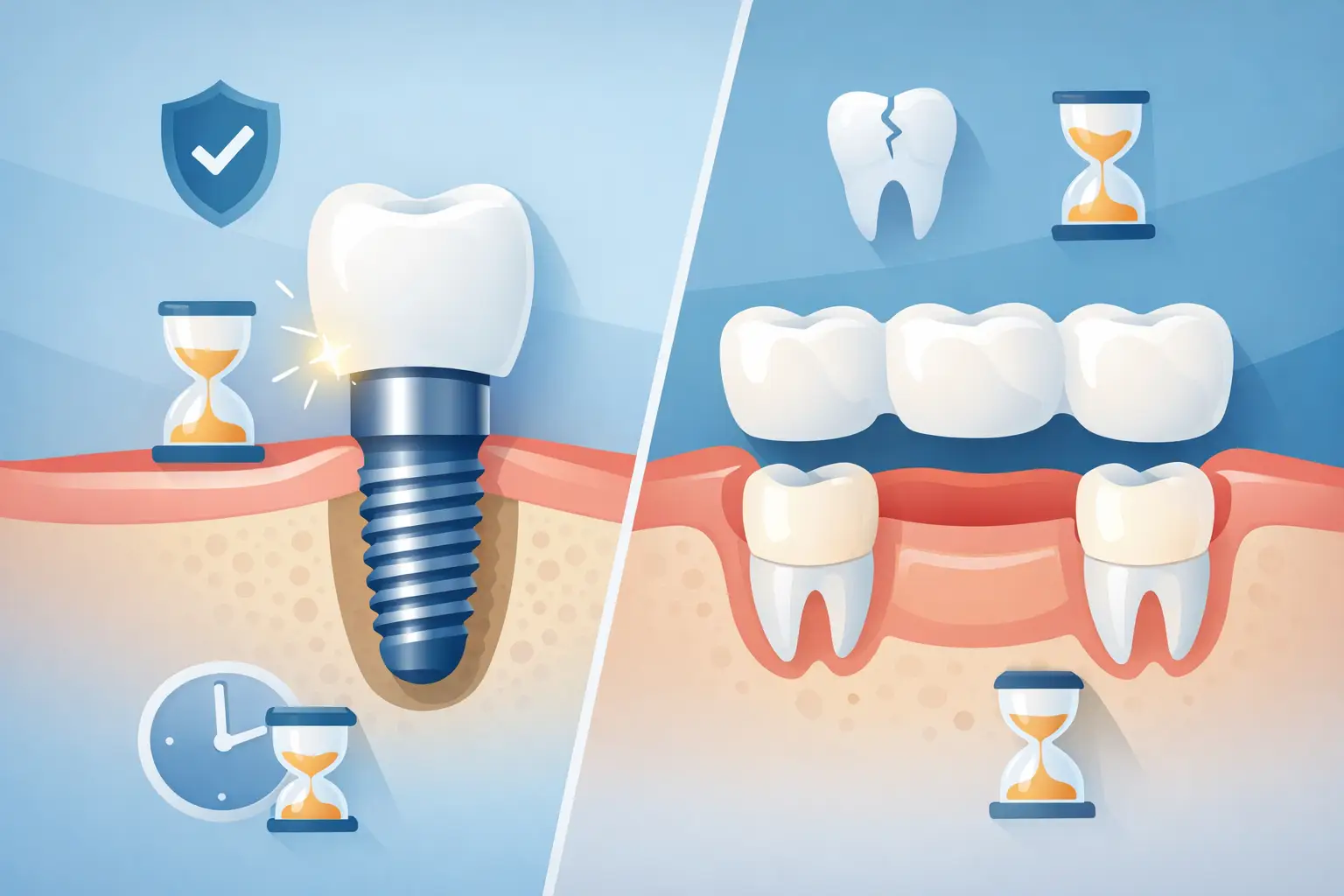
If you are weighing dental implants vs bridges, you are probably not looking for a textbook answer. You want to know which option will feel right, function well, look natural, and hold up over time. That decision matters because replacing a missing tooth is not only about appearance. It affects how you chew, how your bite stays balanced, and how healthy the surrounding teeth and bone remain in the years ahead.
Both treatments can restore a smile successfully, but they work in very different ways. A bridge relies on neighboring teeth for support. A dental implant replaces the missing tooth at the root level by placing a titanium post into the jawbone, then attaching a custom restoration on top. For some patients, a bridge is a practical short-term or medium-term solution. For others, an implant is the more conservative and durable long-term investment.
Dental implants vs bridges: the core difference
The biggest difference in dental implants vs bridges is where the support comes from. A traditional bridge fills the gap by anchoring an artificial tooth to the teeth on either side. Those supporting teeth are typically reshaped so crowns can be placed over them.
A dental implant stands independently. Instead of depending on adjacent teeth, it is placed in the jawbone where the missing root used to be. That design matters because it changes how force is distributed when you bite and how the surrounding structures age over time.
From a patient perspective, both options can look very natural. The more meaningful distinction is what happens beneath the gumline and how much impact treatment has on the rest of your mouth.
When a bridge may make sense
A bridge can be a reasonable option in the right situation. If the teeth next to the gap already need crowns because of large fillings, cracks, or wear, a bridge may solve two problems at once. It can also appeal to patients who want to avoid a surgical procedure or who need a faster timeline in selected cases.
Treatment with a bridge is often more straightforward at the front end. Once the supporting teeth are prepared, impressions or digital scans are taken, and the final restoration is made to fit your bite and smile. For some patients, that path feels more familiar and less intimidating.
That said, a bridge is only as strong as the teeth holding it. If those teeth are healthy and untouched, preparing them means removing natural tooth structure to support the restoration. That trade-off deserves careful discussion.
When an implant may be the better long-term choice
An implant is often the preferred option when the neighboring teeth are healthy. Because it does not require those teeth to be reduced, it preserves natural enamel and keeps each tooth functioning independently.
Implants also help maintain the jawbone. After a tooth is lost, the bone in that area tends to shrink over time because it no longer receives stimulation from the root. An implant can help preserve that bone, which supports facial structure and contributes to long-term stability.
For patients focused on longevity, this is one of the strongest arguments in favor of implants. Under proper conditions and with good maintenance, an implant can provide a stable foundation for many years. In a specialty-focused setting, careful planning, imaging, and surgical precision are what make that outcome more predictable.
Appearance and comfort
Most patients are pleased with the cosmetic result of either option when treatment is well planned. The visible tooth can be matched to your smile, bite, and surrounding teeth. But comfort can feel different depending on the case.
A bridge sits over the gums and spans the missing area, while an implant emerges from the gum more like a natural tooth. That often gives an implant a more tooth-like feel during everyday use. Patients frequently describe implants as more natural when chewing because the restoration is anchored directly in bone rather than suspended between neighboring teeth.
Gum contours, bite forces, smile line, and the location of the missing tooth all influence the esthetic result. This is why treatment planning should go beyond simply filling a space. It should account for how your smile functions and how it will age.
Dental implants vs bridges for longevity
If long-term durability is a major factor, dental implants vs bridges often leans toward implants. Bridges can last many years, especially when they are made well and cared for properly. However, they are more vulnerable to problems involving the supporting teeth, such as decay at the margins, fractures, or changes in the gumline.
An implant has its own maintenance needs, but it is not dependent on neighboring teeth for support. That independence can reduce the risk of a single issue affecting multiple teeth at once. It also means that if one natural tooth develops a problem later, it does not automatically compromise the tooth replacement.
Still, longevity is never one-size-fits-all. A patient with significant bone loss, certain medical conditions, smoking history, gum disease, or heavy bite forces may need additional treatment or a modified plan before an implant is the right choice. This is where advanced evaluation matters.
Cost now vs value over time
Cost is often where the decision becomes more personal. A bridge may have a lower initial fee than an implant, depending on the case. For that reason alone, some patients start there.
But upfront cost is only part of the picture. A bridge may need replacement sooner than an implant-supported restoration, and if one of the supporting teeth develops a problem, treatment can become more involved. An implant can require a greater initial investment, especially if bone grafting or other preparatory procedures are needed, but it may offer stronger long-term value because it preserves adjacent teeth and supports bone health.
Patients should not be pressured into thinking the most expensive option is automatically the best. The right decision depends on your oral health, timeline, goals, and budget. Clear treatment planning should include both immediate cost and expected long-term implications.
Maintenance and daily care
Neither option is maintenance-free. A bridge requires careful cleaning underneath the replacement tooth because food and plaque can collect around the span. That usually means using floss threaders or specialized cleaning tools in addition to brushing.
An implant also requires excellent hygiene. The gums around implants need to stay healthy, and routine professional maintenance is essential. The difference is that cleaning around a single implant crown often feels more similar to cleaning a natural tooth than cleaning under a bridge.
In either case, regular exams matter. Small issues are easier to address early, whether that means inflammation, bite changes, wear, or damage to a restoration.
Who is a strong candidate for each?
A bridge may be appropriate if the adjacent teeth already need crowns, if you are not a candidate for implant surgery, or if timing and budget make a bridge the more realistic option.
An implant may be ideal if you want to preserve neighboring teeth, support the underlying bone, and choose the most independent replacement for a single missing tooth. Patients with adequate bone and healthy gums often benefit from this approach, especially when treatment is planned by a doctor with advanced implant experience.
This is where credentials and case selection matter. For patients considering complex restorative care, working with a practice that understands both the surgical and restorative side of implants can make the process more efficient and more predictable. At Trinity Dental Arts, that comprehensive approach is central to how advanced implant cases are evaluated and delivered.
Questions worth asking at your consultation
Before deciding, ask how each option will affect the neighboring teeth, how long the restoration is expected to last in your specific case, and whether bone loss is already present in the area. You should also ask what happens if the supporting teeth are compromised later, what maintenance will look like at home, and whether your bite places extra stress on the restoration.
A good consultation should not feel rushed. You should see why one option is being recommended over the other and understand the trade-offs clearly. Confidence usually comes from clarity, not sales pressure.
The better choice depends on what you are protecting
Some patients choose based on speed. Some focus on budget. Others are trying to make the most conservative decision for the rest of their smile. That is why dental implants vs bridges is not really a matter of which treatment is better in general. It is a matter of which treatment best protects your oral health, comfort, and long-term goals.
If the neighboring teeth are healthy, preserving them often becomes a major reason to consider an implant. If those teeth already need significant restoration, a bridge may be a very reasonable solution. The smartest choice is the one made after a thorough exam, precise imaging, and a treatment plan built around your mouth, not an average case.
The right tooth replacement should do more than fill a gap. It should support how you eat, speak, smile, and maintain your health for years to come.