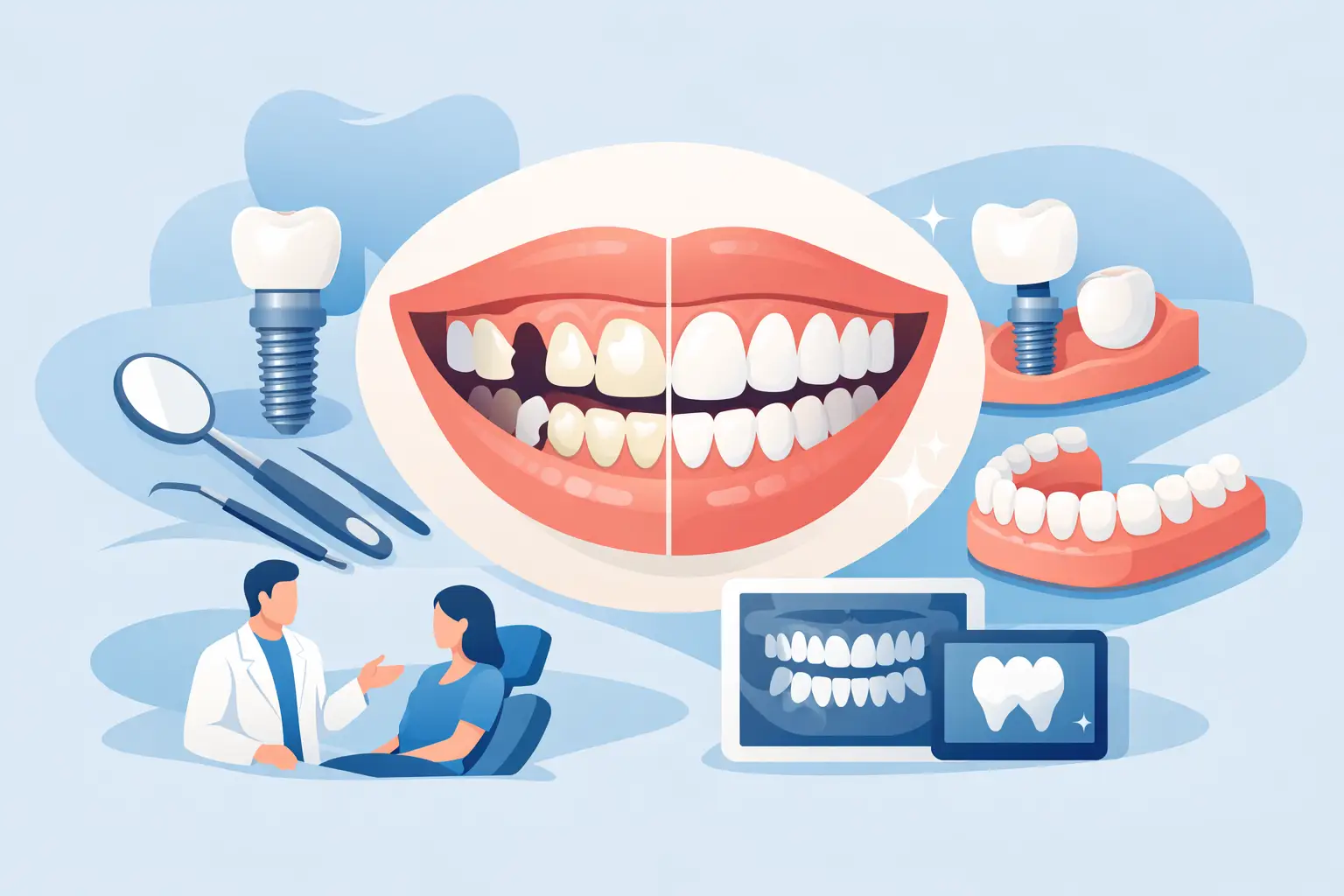
Losing confidence in your teeth rarely happens all at once. For many patients, it builds over years - a cracked crown here, a missing tooth there, gum problems, worn enamel, bite pain, or dental work that no longer holds up. A full mouth restoration guide should do more than define procedures. It should help you understand what is actually being rebuilt, why the right sequence matters, and how to choose a treatment plan that gives you lasting function as well as a better-looking smile.
Full mouth restoration is not one procedure. It is a customized treatment plan that restores the health, strength, appearance, and bite function of most or all teeth in the upper and lower arches. Depending on your needs, that may involve dental implants, crowns, bridges, veneers, periodontal treatment, bone grafting, extractions, or full-arch solutions such as All-on-4 or All-on-X. The right approach depends on what is failing, what can still be preserved, and what will hold up best over time.
What full mouth restoration really means
Patients often assume full mouth restoration is only for people who have lost all of their teeth. That is not the case. Some people still have many natural teeth, but those teeth may be severely worn, broken, infected, or unstable. Others have a mix of missing teeth, old dental work, jaw discomfort, and cosmetic concerns that cannot be solved with a single treatment.
A true full mouth restoration looks at the entire system. That includes tooth structure, gum health, bone support, bite alignment, jaw position, and smile design. If one part is ignored, another part often fails. For example, placing beautiful crowns on teeth without addressing gum disease or bite imbalance can lead to ongoing problems. This is why complex restorative care should be planned comprehensively rather than piece by piece.
Who may need a full mouth restoration
You may be a candidate if daily life is being affected by multiple dental issues at once. Common signs include difficulty chewing, chronic broken teeth, advanced wear from grinding, several missing teeth, loose dentures, recurrent infections, or pain from a collapsed bite. Some patients are also motivated by appearance after years of hiding their smile, but the functional issues are usually just as important.
There is also a difference between cosmetic improvement and restoration. Veneers can improve shape and color, but they are not a substitute for rebuilding a damaged bite or replacing missing teeth. In many cases, aesthetics come after the underlying health and structural concerns are stabilized.
A full mouth restoration guide to the evaluation process
The planning stage is where the quality of treatment is often decided. A thorough evaluation should include a detailed exam, digital imaging, periodontal assessment, review of existing restorations, and a close look at how your teeth come together when you bite and chew. If implants are being considered, bone volume and sinus anatomy may also need to be evaluated.
This is also the stage where an experienced doctor identifies what can realistically be saved. Not every tooth should be removed, and not every tooth should be kept. Saving a compromised tooth may be worthwhile if it has strong long-term potential. On the other hand, holding onto teeth with advanced infection, major structural loss, or poor support can complicate the entire plan.
At Trinity Dental Arts, this level of planning is a major part of care. Dr. Xhoana Gjelaj’s advanced training and implant-focused expertise are especially important for patients with complex needs, because full mouth cases often require both surgical precision and restorative judgment.
Treatment options that may be part of a plan
The best full mouth restoration guide explains options clearly, without pretending there is one ideal answer for everyone. Treatment can range from preserving and rebuilding natural teeth to replacing an entire arch with implant-supported restorations.
If many teeth are still healthy enough to keep, treatment may involve crowns, bridges, periodontal therapy, root canal treatment, and selective implants in areas where teeth are missing. This approach can preserve natural structure, but it may require more appointments and careful coordination.
If damage is more extensive, full-arch implant treatment may be the better long-term choice. All-on-4 and All-on-X solutions are often recommended for patients with failing dentition, significant tooth loss, or teeth that are not predictable enough to restore individually. These systems anchor a fixed set of new teeth to strategically placed implants, giving patients greater stability than removable dentures.
For some patients, bone grafting or sinus grafting is needed before implants can be placed safely. That can extend the timeline, but it may be necessary for long-term implant success. In other cases, enough bone is present to allow for a more immediate treatment path.
Sedation dentistry may also be part of the experience, especially for patients having oral surgery, multiple extractions, or lengthy restorative appointments. This does not change the treatment itself, but it can make the process far more manageable for patients who feel anxious or overwhelmed.
How long full mouth restoration takes
One of the most common questions is how quickly everything can be completed. The answer depends on the complexity of your case, the condition of your gums and bone, and whether healing phases are required. Some patients can move through treatment relatively efficiently, especially when using full-arch implant protocols. Others need staged care over several months.
If active infection, gum disease, or significant bone loss is present, those issues usually need to be addressed first. Rushing into final restorations before the mouth is stable can lead to poor outcomes. On the other hand, a well-organized plan can often improve appearance and function early in the process, even while final healing is still underway.
A realistic timeline matters because this is a major investment of time, energy, and finances. Patients do better when they understand the sequence from the start rather than expecting every case to follow the same schedule.
Cost factors and why estimates vary
There is no standard flat fee for full mouth restoration because the treatment itself is not standard. Cost depends on how many teeth are involved, whether extractions or grafting are needed, the number of implants, the materials used for final restorations, and how complex the bite reconstruction is.
This is one area where cheap treatment can become expensive later. A lower price may reflect shortcuts in planning, lower-quality materials, limited technology, or a plan that solves the visible problem without solving the structural one. That does not mean the highest price is always the best choice, but it does mean patients should look carefully at what is included and who is leading the case.
Financing can make treatment more accessible, especially for patients who have postponed care because the full cost felt overwhelming. What matters most is understanding the long-term value. A properly designed treatment plan should aim to reduce repeated repairs, improve daily comfort, and restore confidence in eating, speaking, and smiling.
Choosing the right provider for a complex case
Full mouth restoration is not the time to think only in terms of convenience. The doctor’s experience, diagnostic process, and ability to manage both surgical and restorative details matter. This is especially true when implants, bone grafting, major bite changes, or cosmetic refinements are involved.
Patients should look for a provider who can explain why a plan is being recommended, what alternatives exist, and where the trade-offs are. For example, keeping more natural teeth may seem appealing, but if those teeth have a poor prognosis, replacement may offer better stability. In contrast, removing salvageable teeth too quickly may not be the most conservative choice. The best treatment planning is confident, but never rushed.
Technology also matters, though it should support expertise rather than replace it. Digital imaging, guided implant planning, and modern restorative tools can improve precision, but they only help when paired with sound clinical judgment.
What to expect after treatment
A successful restoration should look better, but it should also feel more natural and function more predictably. Most patients notice improvements in chewing comfort, speech, facial support, and confidence. That said, there is an adjustment period, especially after major bite changes or full-arch implant treatment.
Maintenance is not optional. Even the most advanced restorations need regular follow-up, professional cleanings, and home care. Implants cannot decay, but the surrounding tissue can still become inflamed if hygiene is neglected. Natural teeth that remain part of the restoration also need ongoing protection.
Nightguards may be recommended for patients who clench or grind. Routine maintenance appointments help catch small issues before they become expensive ones. In other words, full mouth restoration is not a finish line. It is a reset point.
If you are researching your options, the most useful next step is not guessing which procedure you need. It is getting a clear diagnosis from a provider who can see the full picture and build a plan around long-term success, not short-term patchwork.