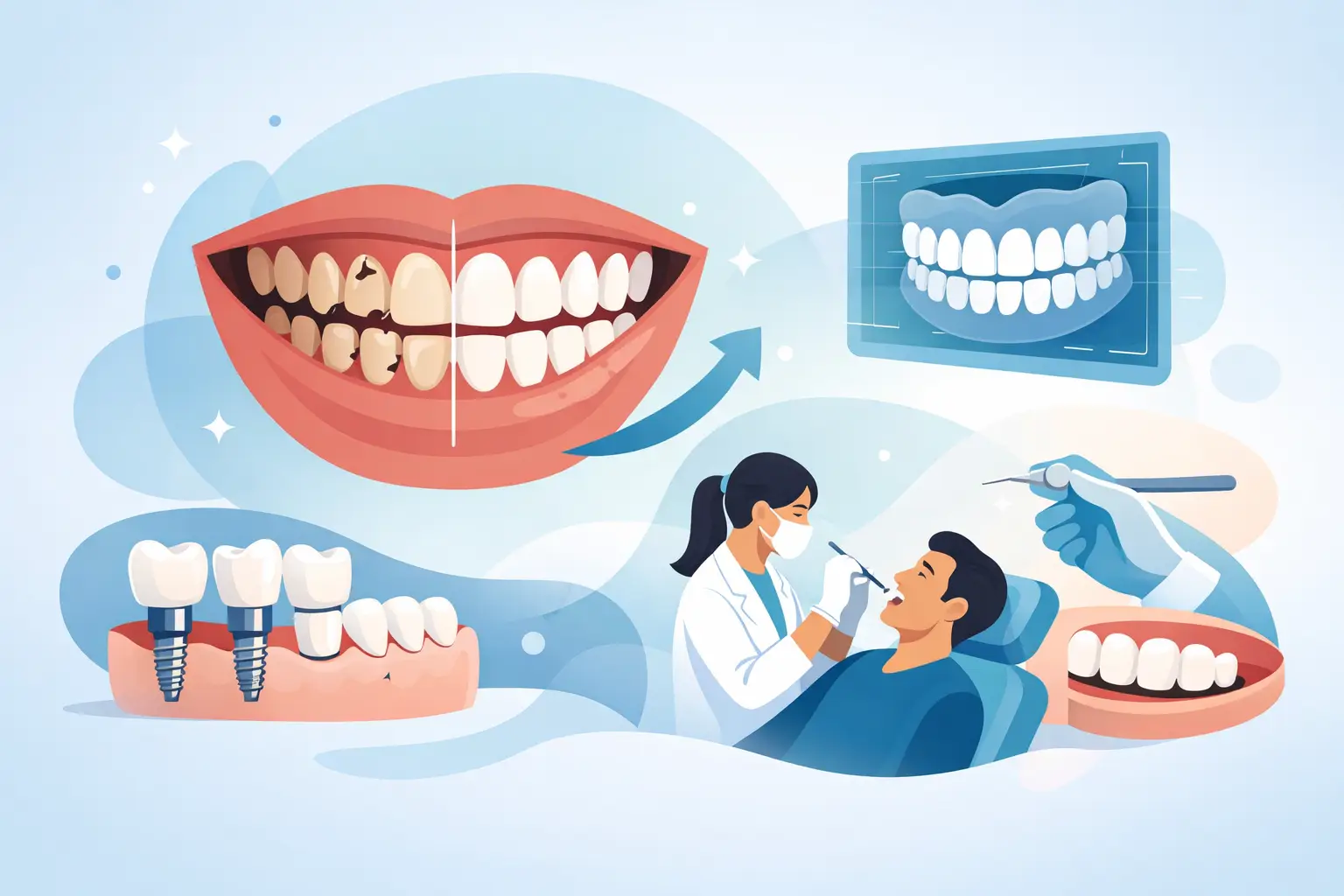
When several teeth are failing at once, the problem is rarely just cosmetic. Chewing gets harder, the bite shifts, older dental work starts breaking down, and even speaking can feel different. That is usually when patients start asking how full mouth restoration works - and whether it can truly rebuild comfort, function, and appearance in a lasting way.
A full mouth restoration is not one procedure. It is a customized treatment plan that rebuilds the teeth, bite, and overall oral health when multiple problems are happening at the same time. Some patients need to replace missing teeth with implants. Others need worn or broken teeth restored with crowns or veneers, gum health stabilized, or the jaw relationship corrected so everything works together again. The goal is comprehensive improvement, not a quick patch.
How full mouth restoration works from the start
The process begins with diagnosis, not treatment. That matters because two patients can look similar at first glance but need very different solutions. One may have advanced tooth wear from grinding. Another may have failing bridges, bone loss, and infection around older teeth. A successful case depends on finding the real causes before any final treatment begins.
At a comprehensive consultation, the dentist evaluates the teeth, gums, bite, jaw joints, bone support, and smile design. Digital imaging, photographs, and 3D scans are often part of that workup. This stage helps answer the questions that shape the entire plan: Which teeth can be saved? Which ones have a poor long-term outlook? Is bone grafting needed for implant support? Has the bite collapsed over time? Are there cosmetic concerns that should be addressed at the same time as the functional ones?
For patients considering advanced implant treatment, this planning phase is where experience matters most. Complex reconstruction requires more than placing teeth back where they used to be. The dentist has to think about force, symmetry, gum contours, facial support, and long-term maintenance. That is why specialty-focused practices such as Trinity Dental Arts place so much emphasis on diagnostics and treatment sequencing under the direction of an experienced clinician like Dr. Xhoana Gjelaj.
What a full mouth restoration may include
The exact treatment mix depends on what is damaged, missing, infected, worn down, or esthetically compromised. In many cases, full mouth restoration combines several disciplines of dentistry into one coordinated plan.
Dental implants are often used to replace missing or non-restorable teeth. For some patients, that means single implants in selected areas. For others, it may mean a full-arch solution such as All-on-4 or All-on-X fixed teeth when an entire upper or lower arch needs to be rebuilt.
Crowns are commonly used when teeth are still salvageable but weakened by cracks, large fillings, or severe wear. Veneers may play a role in select cases when front teeth need shape, color, and surface improvement, though they are not a substitute for correcting deeper bite problems. Periodontal treatment may also be necessary if gum inflammation or bone loss is undermining the foundation of the teeth.
Some patients need preparatory procedures before final restoration can begin. Bone grafting and sinus grafting may be needed to create enough support for implants. Orthodontic treatment such as Invisalign can help reposition teeth if crowding or bite imbalance is contributing to the problem. Sedation dentistry may also be part of the plan for patients with significant anxiety or for longer treatment appointments.
The sequence matters as much as the procedures
One of the biggest misconceptions is that full mouth restoration is simply a matter of choosing restorations and placing them. In reality, order matters. If the foundation is unstable, the final dentistry will not last the way it should.
Treatment often starts by controlling disease and removing problems that can interfere with healing. That may include treating infection, improving gum health, extracting teeth that cannot be predictably saved, or placing implants in strategic areas. In some cases, temporary restorations are used to test a new bite position before final teeth are made.
This step is especially important when teeth have worn down unevenly or when the patient has been compensating for missing teeth for years. Rebuilding the bite changes how the upper and lower teeth meet. A good plan accounts for muscle comfort, speech, chewing efficiency, and facial balance, not just the appearance of individual teeth.
After healing and stabilization, the dentist moves into the restorative phase. Final crowns, implant restorations, or full-arch prosthetics are designed with precision so they look natural and function properly together. This is where high-level cosmetic and restorative planning overlap. Teeth should look attractive, but they also need to distribute force correctly and be maintainable over time.
Why full mouth restoration is different from a smile makeover
Patients sometimes use these terms interchangeably, but they are not the same. A smile makeover focuses mainly on esthetics. Full mouth restoration focuses first on health and function, then integrates esthetics into the final result.
That distinction matters when there is structural damage. If someone has broken teeth, bite collapse, missing teeth, chronic wear, or failing restorations, cosmetic improvements alone will not solve the underlying problem. The dentistry has to restore strength and stability first. The visual transformation can be dramatic, but it should be built on sound clinical planning.
In many cases, the best results come from treating both sides of the equation. A patient wants to chew comfortably and stop breaking teeth, but they also want a smile that looks natural, balanced, and confident. Comprehensive care makes both goals possible when the treatment is properly designed.
How long full mouth restoration takes
There is no one-size-fits-all timeline. Some cases can move relatively quickly, while others take several months depending on healing, complexity, and whether surgical procedures are involved.
A patient who needs crowns, selective implant placement, and minor bite correction may finish much sooner than someone who needs extractions, grafting, implant healing, and full-arch reconstruction. Immediate solutions are possible in some implant cases, but immediate does not always mean appropriate. The right pace depends on bone quality, infection risk, tissue health, and how predictable the final outcome will be.
This is one area where honest expectations matter. Faster is not always better if it compromises precision or longevity. A carefully sequenced treatment plan often delivers the strongest long-term result.
Cost, maintenance, and long-term value
Full mouth restoration is a significant investment because it addresses multiple problems at once and often involves advanced planning, laboratory work, surgery, and custom restorations. The total cost depends on how many teeth are involved, what procedures are needed, and whether implants or grafting are part of the case.
What patients are really weighing is not just price, but value over time. Repeatedly repairing broken teeth, replacing failing dental work, and living with unstable function can become expensive in its own right. A comprehensive plan aims to solve the larger problem instead of chasing symptoms one tooth at a time.
That said, long-term success still depends on maintenance. Even excellent dentistry can fail early if gum disease returns, grinding is unmanaged, or follow-up care is neglected. Most patients will need regular professional maintenance, excellent home care, and sometimes a night guard to protect their investment.
Who is a good candidate?
The best candidates are adults dealing with multiple significant dental issues who want a lasting solution rather than temporary repairs. That can include people with missing teeth, extensive wear, repeated crown failure, trauma, bite instability, or a combination of cosmetic and functional concerns.
Not every patient needs the most extensive version of treatment. Sometimes a conservative phased approach is the right choice. Sometimes implants are clearly the best foundation. Sometimes healthy teeth should absolutely be preserved rather than replaced. The right plan is the one that fits the patient’s condition, goals, health history, and budget while still protecting long-term predictability.
For patients in Trinity and the greater Tampa Bay area, the most important step is choosing a provider with the training and experience to manage both the surgical and restorative sides of care. Full mouth restoration works best when it is guided by precise diagnosis, thoughtful sequencing, and a clear vision for the final result.
If you are weighing your options, the most useful question is not whether full mouth restoration is a big treatment. It is whether the right plan could finally give you a stable bite, stronger teeth, and the confidence to stop worrying every time you eat or smile.