When multiple teeth are failing or missing, the decision is larger than choosing a replacement tooth. You are choosing how you want to eat, speak, smile, and protect your oral health for years ahead. In the All-on-4 vs All-on-6 conversation, both treatments can provide a fixed, full-arch set of new teeth supported by dental implants. The right approach depends on the condition of your jawbone, bite forces, health history, smile goals, and long-term treatment plan.
At Trinity Dental Arts, Dr. Xhoana Gjelaj evaluates these factors carefully rather than recommending a one-size-fits-all solution. A full-mouth restoration should be built around the biology of your mouth and the function you need from it.
What All-on-4 and All-on-6 Have in Common
All-on-4 and All-on-6 are full-arch dental implant solutions. Instead of replacing teeth one at a time, a complete fixed bridge is secured to a strategic number of implants placed in the upper jaw, lower jaw, or both. The result is a stable, non-removable set of teeth designed to look natural and restore reliable chewing function.
Both options begin with detailed diagnostics. Advanced imaging helps the implant dentist assess available bone, sinus position in the upper jaw, nerve location in the lower jaw, gum health, bite alignment, and the condition of any remaining teeth. If teeth need to be removed, this can often be coordinated as part of the overall surgical plan.
For qualified patients, a fixed temporary bridge may be placed on the day of surgery. This allows you to leave with teeth in place while healing occurs. After the implants integrate with the jawbone and the bite has been refined, a final custom restoration is created for long-term strength, esthetics, and comfort.
All-on-4 vs All-on-6: The Core Difference
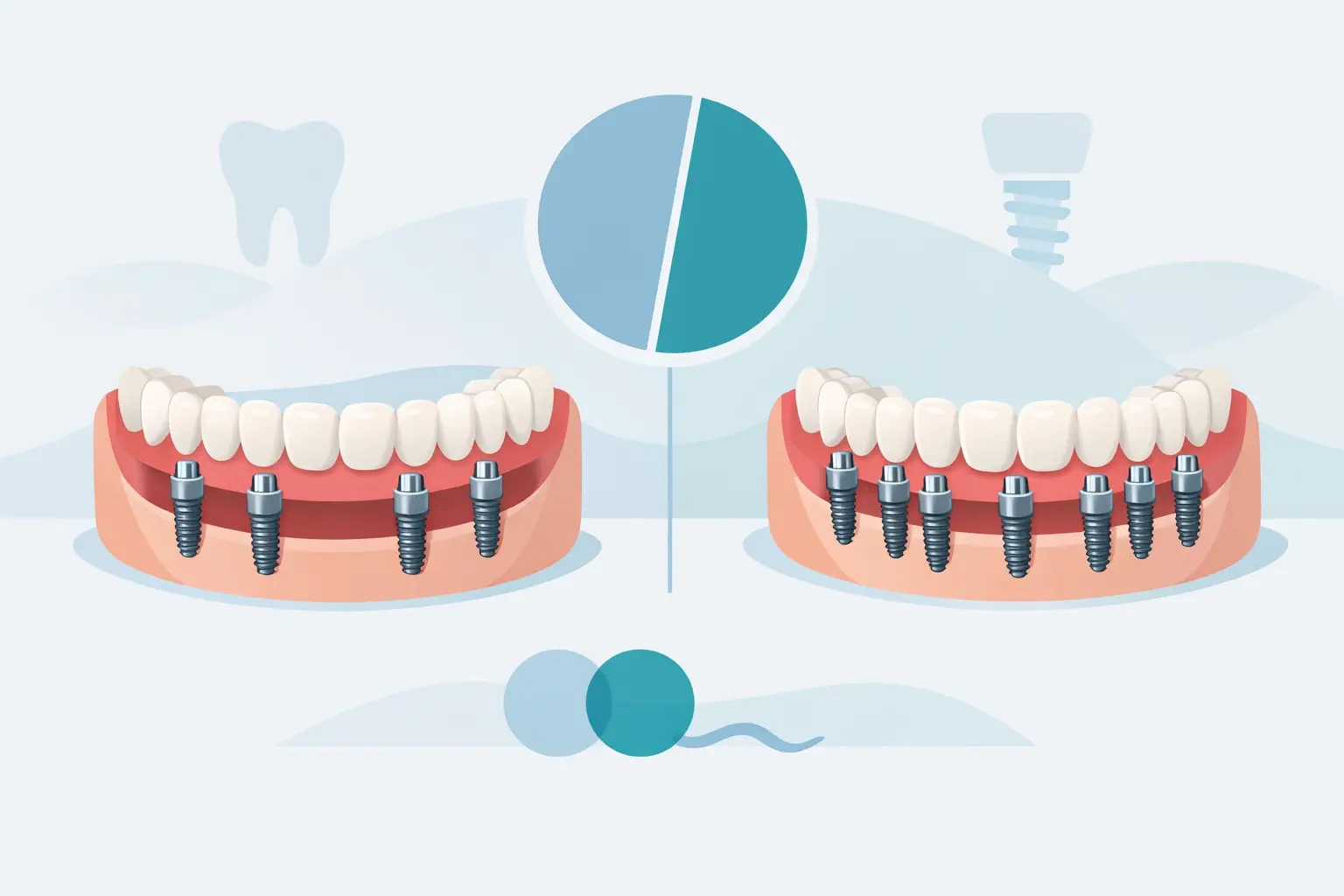
The primary difference is the number of implants supporting the full-arch bridge. All-on-4 uses four implants, while All-on-6 uses six. More implants do not automatically mean a better outcome for every patient. However, the additional support in an All-on-6 design can be beneficial when anatomy, bone quality, or bite demands call for a broader foundation.
All-on-4 is designed to make efficient use of existing bone. The back implants are often angled to increase contact with available bone and avoid certain anatomical structures. This can make full-arch treatment possible for patients who have experienced bone loss and may reduce the need for additional grafting in some cases.
All-on-6 places two additional implants across the arch. This may distribute chewing forces more broadly and offer added support for the final bridge. It is often considered when the patient has sufficient bone volume, a strong bite, a wider arch, or clinical factors that favor more implant support.
Neither treatment should be selected by implant count alone. The better question is: what design gives your new teeth the best chance to function predictably and remain stable over time?
When All-on-4 May Be the Right Choice
All-on-4 can be an excellent choice for patients with significant tooth loss, failing teeth, or reduced bone in the back of the jaw. By using angled posterior implants, the treatment can often avoid areas where bone is limited. That may shorten the path to fixed teeth for the right candidate.
This approach can also be appropriate when four properly positioned implants can support the planned bridge and bite. A carefully engineered prosthetic design matters just as much as the surgical placement. The bridge must be shaped to manage biting pressure effectively and provide the support needed for a natural-looking smile.
Patients sometimes assume that All-on-4 is simply the lower-cost option. While it may involve fewer implants, treatment costs are influenced by much more than implant quantity. Extractions, bone grafting, sedation, temporary teeth, final materials, diagnostic imaging, and the complexity of the case all contribute to the total investment.
When All-on-6 May Offer an Advantage
All-on-6 may be recommended when additional implant support can improve the long-term design of the restoration. The two extra implants can help distribute forces across the jaw, which may be especially valuable for patients who generate greater bite pressure or have a history of grinding or clenching.
It can also be a strong option for patients with adequate healthy bone throughout the arch. Where anatomy allows, six implants may provide greater flexibility in bridge design and a more extensive support pattern. In some cases, this can be helpful for maintaining a stable, comfortable bite over time.
That said, All-on-6 requires enough quality bone in the intended implant locations. If the bone is not adequate, grafting or another treatment plan may be needed before implants can be placed. More implants also mean additional surgical sites, which can affect treatment complexity and cost.
Bone Quality Matters More Than the Number Alone
Jawbone is not the same from patient to patient. Bone density, height, width, and the pattern of bone loss can vary substantially, even between the upper and lower jaw in the same person. This is why a consultation without comprehensive imaging cannot determine whether All-on-4 or All-on-6 is the better fit.
The upper jaw often presents different challenges than the lower jaw because the bone can be less dense and the sinus cavities limit available space in the back. The lower jaw may have denser bone but requires careful planning around the nerve that provides feeling to the lip and chin. An experienced implant provider uses three-dimensional imaging to plan placement with precision and protect these important structures.
If bone grafting is necessary, it is not a sign that treatment has failed or become impossible. It is a tool for creating a healthier foundation when the jaw needs more support. The decision depends on whether grafting will improve the predictability of your outcome and whether it fits your treatment priorities.
What Healing and Daily Life Look Like
The surgical experience and early healing period are generally similar for All-on-4 and All-on-6. Sedation options can help patients who feel anxious about treatment or who are completing extensive work in one visit. After surgery, you will follow a carefully managed diet and hygiene routine while the implants bond with the jawbone.
During this phase, your temporary bridge is not meant to function like the final restoration. A softer diet protects the implants from excessive force while healing takes place. Following instructions closely is essential, particularly for patients who clench, smoke, have uncontrolled diabetes, or have a history of periodontal disease.
Once healing is complete, the final bridge is designed to refine the smile, bite, tooth shape, and color. Routine professional maintenance remains important. Although implant-supported teeth cannot decay, the gums and bone around implants still need consistent care to remain healthy.
Questions to Ask at Your Consultation
A high-quality consultation should give you a clear explanation of why a particular design is being recommended. Ask how your bone quality affects the plan, whether any grafting is advisable, what type of temporary and final bridge will be used, and how your bite will be managed. You should also understand the expected healing timeline, maintenance needs, financing options, and what is included in the proposed treatment.
It is also reasonable to ask about the provider's experience with full-arch implant surgery and restoration. Full-mouth treatment requires more than placing implants. It requires surgical planning, restorative expertise, bite management, esthetic judgment, and the ability to address complications if they arise.
Choose the Foundation That Fits Your Future
For some patients, All-on-4 provides a highly effective path to fixed new teeth with efficient use of available bone. For others, All-on-6 offers additional support that better suits their anatomy and functional needs. The goal is not to choose the treatment with the larger number. It is to choose a precisely planned solution that gives you confidence in every meal, conversation, and smile.