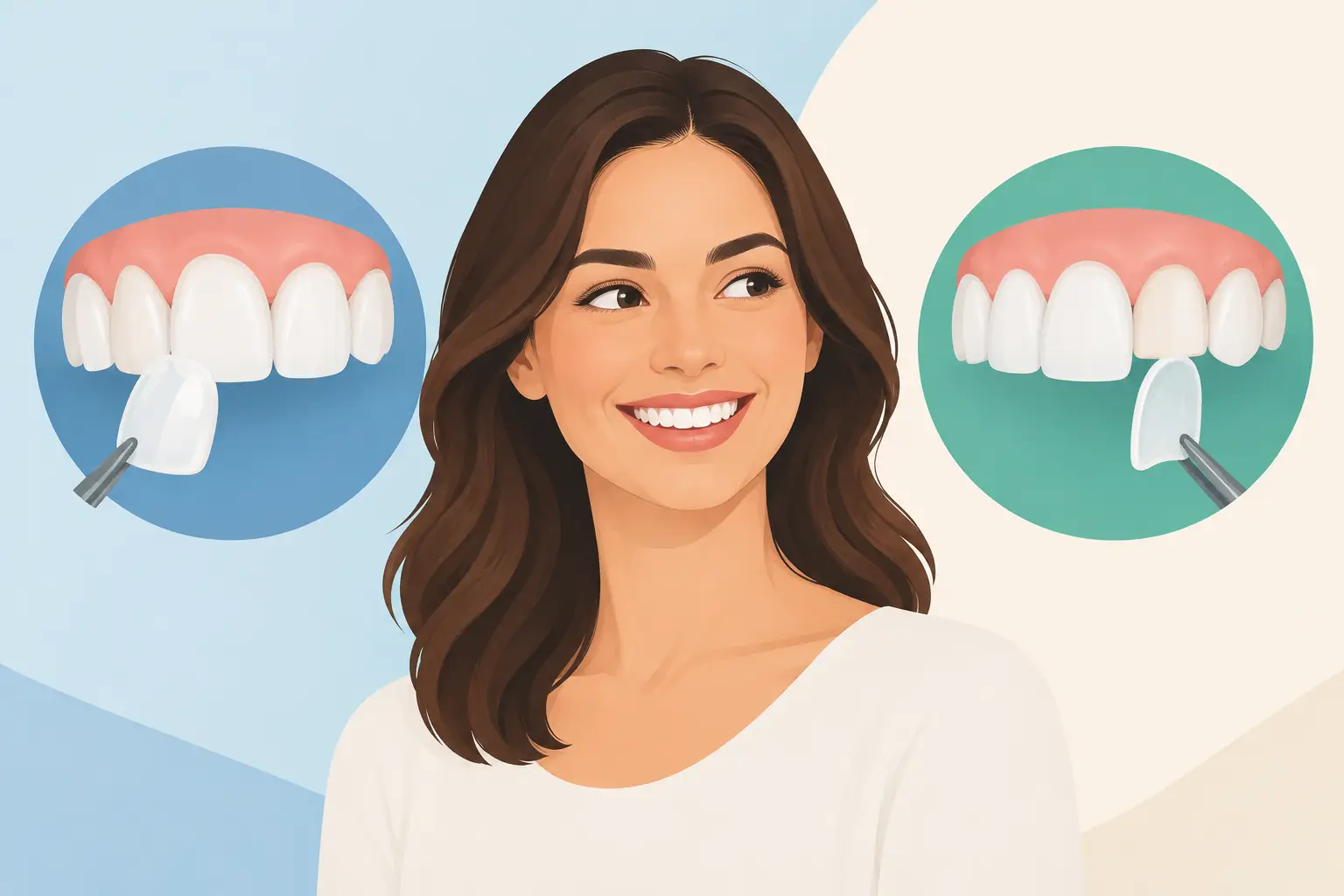
A brighter, more balanced smile can change how you feel in photographs, conversations, and professional settings. But when researching veneers vs Lumineers, the choice is not as simple as selecting the thinnest option. The right treatment depends on your tooth color, enamel, bite, gum health, and the degree of correction your smile actually needs.
Both treatments use porcelain to improve the visible front surface of teeth. Both can address discoloration, small gaps, uneven edges, worn enamel, and minor shape concerns. Their differences matter because cosmetic dentistry should do more than create an attractive result. It should support comfortable function, healthy gums, and a smile designed to last.
Veneers vs Lumineers: The Core Difference
Traditional porcelain veneers are custom restorations that are bonded to the front of natural teeth. To create natural contours and avoid a bulky appearance, the dentist commonly removes a small amount of enamel before placement. This preparation creates room for the porcelain and allows the veneer to sit in harmony with adjacent teeth.
Lumineers are a branded type of very thin porcelain veneer. They are often marketed as requiring little or no tooth reduction. In some cases, that conservative approach may be appropriate. However, minimal-prep does not automatically mean better. If a tooth is already prominent, dark, rotated, or heavily worn, placing porcelain over it without enough preparation can create an overly thick result or make it difficult to achieve natural color and proportions.
The real question is not whether tooth preparation can be avoided. It is whether the treatment plan can produce a healthy, natural-looking smile without compromising the result.
When Traditional Veneers May Be the Better Choice
Porcelain veneers offer exceptional versatility because they can be designed with greater control over color, shape, size, and translucency. They are often recommended when patients want a noticeable smile makeover or have concerns that require more than a thin layer of porcelain to correct.
Veneers may be a stronger option for teeth with deeper discoloration, especially staining that does not respond well to whitening. They can also be effective for teeth that are chipped, unevenly shaped, slightly crowded, spaced apart, or shortened from years of wear. Because the dentist creates a controlled amount of space for the restoration, traditional veneers can often deliver a more refined profile and a more natural transition at the gumline.
The trade-off is that enamel preparation is usually irreversible. Although preparation is conservative, it is still a permanent change to the tooth. Once a tooth has been prepared for a veneer, it will generally need to remain restored with a veneer or another appropriate restoration in the future.
For patients seeking a comprehensive smile transformation, that permanence may be an acceptable and worthwhile part of achieving a precise result. A thoughtful cosmetic evaluation should make that decision clear before treatment begins.
When Lumineers May Be Appropriate
Lumineers can be a reasonable option for patients whose teeth are already well positioned, relatively light in color, and small enough to accept a thin porcelain layer without looking enlarged. They may work well for subtle improvements, such as smoothing minor edge irregularities, closing small spaces, or adding modest length to worn teeth.
The appeal is understandable. Less tooth reduction can preserve more natural enamel, and treatment may feel less invasive for the right patient. Yet no-prep or minimal-prep cosmetic dentistry requires careful case selection. A restoration that is too thick can affect lip support, speech, bite comfort, and how naturally the teeth reflect light.
Lumineers are not necessarily reversible simply because little preparation may be used. Removing bonded porcelain can still be challenging and may affect the underlying tooth surface. Patients should view either option as a long-term cosmetic commitment rather than a temporary accessory.
Appearance: Thin Is Not Always More Natural
A successful cosmetic result is not determined by how little porcelain is used. It is determined by proportion, color, texture, translucency, and how the restorations fit the face.
Natural teeth are not flat white rectangles. They have subtle color variation, light reflection, and contours that complement the lips and gums. High-quality porcelain can replicate these details, but the dentist needs enough control to design the right shape and thickness for each tooth.
For example, a patient with naturally small teeth and minimal discoloration may be an excellent candidate for thin, conservative restorations. A patient with dark internal staining may need traditional veneers with enough thickness to mask the underlying color without creating a gray or overly opaque appearance. Someone with visible crowding may benefit from orthodontic treatment before veneers rather than relying on porcelain alone to camouflage a more significant alignment issue.
This is why digital smile planning, photographs, bite analysis, and a detailed discussion of your goals are so valuable. The best cosmetic plan is built around your existing teeth, not around a one-size-fits-all product label.
Durability, Maintenance, and Bite Considerations
Both veneers and Lumineers are made from durable dental porcelain and can provide years of service with excellent care. Longevity varies based on the material used, how well the restoration is bonded, oral hygiene, bite forces, and habits such as clenching, grinding, chewing ice, or biting hard objects.
Patients who grind their teeth may need a custom nightguard to protect their cosmetic work. This is especially important because porcelain can chip or fracture under repeated excessive force. A dentist should also evaluate whether the front teeth receive too much pressure during biting and chewing. If the bite is unstable, cosmetic restorations may be at greater risk regardless of whether they are veneers or Lumineers.
Daily care is straightforward: brush twice a day with a nonabrasive toothpaste, floss carefully, and maintain regular professional cleanings. Porcelain itself does not stain like natural enamel, but the edges where the restoration meets the tooth can still collect plaque if home care is inconsistent. Coffee, red wine, and tobacco can also affect nearby natural teeth, which may eventually create a color mismatch.
Cost Factors to Consider
Costs for veneers and Lumineers vary based on the number of teeth treated, the complexity of your case, the type of porcelain selected, and the level of planning required. A single veneer used to repair a chipped tooth is a different treatment from a full smile makeover involving multiple front teeth.
It is also wise to look beyond the initial price. A less expensive cosmetic option is not necessarily a better value if it produces a bulky appearance, fails to correct the underlying concern, or needs replacement sooner than expected. Cosmetic dentistry is highly individualized work. The quality of the diagnostic process, design, materials, and bonding technique all influence the final result.
At Trinity Dental Arts, Dr. Xhoana Gjelaj approaches cosmetic care with the same attention to planning and long-term function used in advanced restorative treatment. That means looking closely at your teeth, gums, bite, and overall smile goals before recommending a specific solution.
How to Decide Between Veneers and Lumineers
The most reliable way to choose is through an in-person cosmetic consultation. Your dentist should evaluate the amount of healthy enamel available, the position of the teeth, existing restorations, gum symmetry, bite relationship, and the shade changes you hope to achieve.
Bring examples of smiles you like, but remain open to individualized guidance. A smile that looks natural and attractive on another person may not suit your facial proportions or dental structure. Your treatment should be designed for your features, not copied from a photograph.
If your concerns are mild and your teeth provide the right foundation, Lumineers or another minimal-prep approach may be worth considering. If you need more comprehensive changes in color, contour, spacing, or alignment, traditional veneers may provide greater predictability and a more polished result.
The most confident choice is the one that protects your natural teeth while giving you a smile that looks like it has always belonged to you.